
WelcomeUser Guide
ToSPrivacyCanary
DonateBugsLicense

©2025 Poal.co

932

Never thought about it much but seems curiously bullshit and man made

Never thought about it much but seems curiously bullshit and man made

(post is archived)

[–] 10 pts

Nope. In fact Jesus himself makes clear church is where you preach. Be it in your home or a hill side; together or alone. Church isn't a singular building; unlike temple. Likewise, Christianity specifically moves away from a clergy class and theistic rule. The relationship is directly between you and God. Explicitly, no clergy is required to be Christian.

But the Catholic church inserted itself into everything, including marriage, idol and pagan worship, clergy, and control of the canon material locked behind literacy, Greek, and Latin.

Enter the KJV, which made it more accessible. But literacy remained an issue. As did incorrect translations. To date, many translation errors remain. Some accidental. Some because of catholic doctrine conflict. Some because of political correctness. And some because it undermines Jewish interaction of control into the new testament. Some willfully injected by Jews under the banner of translation corrections.

[–] 3 pts

The church Christ spoke of many times is IN YOU, He in you. Religion teaches of buildings when the temple reference Christ used is a body unified and spirit-filled. Satan directs all religions, all denominations.

[–] 9 pts

What? know ye not that your body is the temple of the Holy Ghost which is in you, which ye have of God, and ye are not your own?

This is why the Jewish pharisees saw Jesus as such a threat to their corruption, deception, and power base.

For we wrestle not against flesh and blood, but against principalities, against powers, against the rulers of the darkness of this world, against spiritual wickedness in high places.

With the correct translation of:

Behold, I will make them of the synagogue of Satan, which say they are [Israelites] , and are not, but do lie; behold, I will make them to come and worship before thy feet, and to know that I have loved thee.

Christianity is the antibiotic to the corruptions of Judaism and especially talmudic (pharisees oral traditions) Judaism.

Technically, Christianity is older than Talmudic Judaism. It's why it explicitly identifies Jesus as a evil and boiling in excrement. The talmud is the written record of the oral traditions of the pharisee priesthood. The bible explicitly mentions their oral traditions and corruptions.

You can always identify Jews by their hatred of Christianity.

Just for additional learning: https://poal.co/c/0d962bc7-75a1-4242-b48e-ad3438ebc7bb#cmnts

[–] 0 pt

Well-versed some 30yrs now. Religion free as well.

[–] 7 pts

The Church is the kingdom of darkness, the counterfeit for the real kingdom of God.

"The kingdom of God cometh not with observation ... look here ... look there ... for the kingdom of God is WITHIN you.

The Creator is raising us up like seeds that will one day grow into trees. The Church is Satan's kingdom, the counterfeit, run by eaters of children and Roman faggots.

Jesus never established a Church. He established a kingdom. Only those who are in that Kingdom know they are in it. Everyone else is dead, deaf, dumb, and blind to it, and rages against it.

The clowns who come here calling people "christcuck" are dickcucks because they worship biological race instead of the one who created biological race. So they are dick worshippers just like the Catholics.

[–] 0 pt

Yeah... what ↑he said; except less polite.

[–] 0 pt

BINGO! Never chase after the nonessentials many believe to be qualifiers or something. Those with eyes see,ears hear. Everything else is legalist bullshit that NEVER lines up with Kingdom principles.

[–] 2 pts

If you are talking about the Kingdom of God, the Greek actually says that it is among you. The field is the world. The Kingdom is here on the earth. The children of the wicked one do control the kingdom at this time. Matthew 13 is a good source for this.
[–] [deleted] 4 pts

Nah… they made it up.

[–] 1 pt

Unlike what, the jews/heebs that wrote the rest of the bible guide to being a good obedient goyim?

I met a guy from central America, he didn't much care for white people and boasted about his traditions. I didn't know how to break it to the guy that all of his "traditions" were from white(ish) people in Spain. His people's traditions and history was mostly erased. The true history of his people was twisted into tales of barbarism and cannibalism.

Even more fascinating to me is that native Europeans are just as completely blind to the fact their their customs and traditions were mostly erased as well. Their history also twisted into tales of barbarism. Thank goodness the middle eastern religion showed up and put the mythical figure god before their own bloodline. Bloodlines and traditions that had most likely lasted for thousands, if not tens of thousands of years, were erased and now christcucks go around like good little goyim defending the very religion that wiped out their own history and traditions. A "religion", aka set of goyim rules, that has only been a very recent part of their history.

We were all duped, all of us. Every single thing wrong with white people is that we lost who we were, we placed the jewish god before our own ancestors.

[–] 0 pt

As you put it. For many people in the world today, their traditional values simply no longer exist. The traditions of their grandparents are mostly devoid of any history beyond a generation or two. For many people, their history is so far gone there's no hope to get it back.

And if you could would you want a culture designed for a time with no running water?

So the ultimate question is what to do when faced with this difficult reality? Do we revert? To what, and how do we define it? Or do we simply go mad, as we are lost in time seemingly with no purpose or truth in our lives?

If it's not obvious to everyone. The correct answer is to build something new. Something which honors our true roots but which is designed to proper within the modern age that we exist. But this requires everyone tries to participate in a genuine effort to accomplish this goal.

[–] 0 pt

It is very simple. Your bloodline and your ancestors come first, before all else. They are the only thing that is real and tangible. Anything else is just a "belief". You don't need to have "faith" that your bloodline goes back to the beginning, the simple fact that you exist is proof of that. Your life shouldn't be based around some kike writing bedtime stories or some lightning bolt tossing god. There is only two possible outcomes, you die and are gone forever or there is an afterlife. If option 1, then have children and honor your bloodline and be immortal through them. If option 2, get ready to face 10,000+ ancestors and explain your life and your choices to them. I doubt many would be impressed with your ability to get on your knees to worship some made up kike god. If people thought like this, you wouldn't have trannies, you wouldn't have people jerking off all day to kike porn and you wouldn't have weak soy faggots who are afraid of hard work.

[–] 4 pts

No. Definitely not Bible based. Much of it is rooted in Paganism.

[+] [deleted] 3 pts
[–] 3 pts

Daniel chapters 2 and 7 give an account of what will come, and are viewed by some denominations as prophetic descriptions of the formation of the Catholic Church, as well as its practices and things that it has done over the centuries.

[–] 2 pts

I think there is quite a bit about the Pope and the Catholic Church in the Bible. It’s the feet of iron mixed with clay in Nebuchadnezzar’s dream, the 4th beast in Daniel’s prophecy, and the first beast in John’s Revelation. Everything that church teaches/stands for is against the commandments of God, and Daniel was given the vision of it all the way back in the time of Babylonian rule. They worship false idols, prop Mary up as equal/greater than to Jesus; while saying she is intercessor (which would negate his sacrifice). The changed dates and times, claimed to move the sabbath day from the 7th day (Saturday) to the first (Sunday) and claim that grace alone saves men, which requires no faith or keeping of God’s commandments.

[–] 1 pt

claimed to move the sabbath day from the 7th day (Saturday) to the first (Sunday)

Im torn on this, is the real sabbath day on Saturday or Sunday. jews also seem to worship the sabbath on the Saturday too.

[–] 1 pt

The Catholic Church stated themselves that Sunday solemnity is their own decree and anyone who uses the Bible alone, and not Catholic tradition, would keep Saturday. There is nothing in the Bible that supports Sunday as a sabbath, nor anything allowing a church to alter the day.

[–] 0 pt

But then what if thats the jews want us to think and they want us to worship on their day. Thats what im worried about.

[–] 0 pt

The sabbath day is not a day in the calendar. That is Seventh-Day Adventist cultist religious bull.

The sabbath day is Jesus Christ, when the day star arises in your heart. It has nothing to do with a calendar day for observing useless rituals. To rest is to live in Christ and have Christ living in you. It has NOTHING to do with visible observances.

The Seventh-Day Adventist Church repeats most of the errors and lies of Rome, and is a man-made religion leading people far away from the truth of the Creator.

[–] 0 pt

I’m not a Seventh Day Adventist, nor a member of any organized religion. I think the seventh day is still significant because God set it apart and made it clear that it was to be a set apart day for all generations. I don’t do any rituals on the sabbath, I just chill at home with my family.

[–] 1 pt

Nope. The whole experiment should have been put to an end when the pope said he's literally God in the flesh.

[–] 2 pts

the Pope is gay, F that faggot

[–] 1 pt

ITT: angsty fuckos who never opened a Bible

'Catholic' just means universal, as in universal and one true Christianity. Anything outside of the one true and universal church is just in various states of denial, schism and all the way up to heresy.

"You are peter(rock) and on this rock(peter) I will build my Church" regarding Peter as the first Pope and leader of the Church.

"I will make you fishers of men" regarding priests.

"Whatever you bind on earth is bound in heaven and whatever you loose on earth is loosed in Heaven" regarding the sacrament of confession.

Good enough?

[–] 2 pts

The Catholic Church was founded by Saint Peter, chosen out of all apostles to lead the Church after Jesus left this world to ressurect in the spirit. Saint Peter is the first Pope, and recreated the entire apostolate of Jesus in Rome. All other denominations are sectarian cults that seceded in a certain point of history.

[–] 0 pt

Your Catholic "interpretation" of scripture is an abomination.

If you read the scripture in its entirety without cherry picking half a verse out of context, you would see Jesus was saying that He and the Holy Spirit are the rock of foundation, not Peter.

The Catholic Church is Edomite to the core, and Esau is the enemy of Jacob. The Catholic Church is a hive of kid-fuckers and child-eaters, hardly a place of righteousness.

[–] 0 pt

My interpretation has thousands of doctors who lived and studied the scripture. No understanding is made before one knows everything the wise knew.

But your "interpretation", which ignores one thousand years and admits that all personal interpretations are "correct", since anyone can study it, is the good one.

And tell me again, how is this not erasing history?

[–] 1 pt

You a delusional Satan worshiping fucktard. To take those statements and some how conflate that to the Bible describing a pope who talks directly with God and priest who only did serviced in Latin so the locals couldn't understand! Is truly only a special special gamma boy could believe.

Jesus should have said exactly what he wanted in a church and he certainly didn't mention owning land having gay priest and nuns and all the child fucking the catholic church ended up doing or promoting.

Just go suck some jew dick you zionist shill

[–] 0 pt

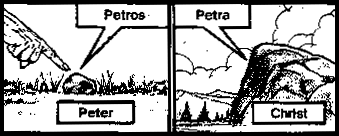
Jesus did not say he would build his church on Simon Peter. Jesus called Simon "Petros" (a movable stone) and then followed that the church will be built on "Petras" (an immovable rock). Jesus is the Petras that the church is built on.

https://www.endtime.net/images/18.gif

[–] 0 pt

Jesus spoke Aramaic, not Greek, and said 'Kepha' both times.

Also realize Jesus is God and therefore omnipotent. He would have known at the time at if he worded anything ambiguously, people would do the wrong thing for 2000 years. I think he wouldn't have been ambiguous.

[–] 1 pt (edited )

Odd, we don't call him Simon Kepha for some reason. Maybe because Greek was used for the wordplay. So while Jesus spoke in Aramaic he used Greek at this point. Also, since scripture is inspired by God, He had Matthew write Petros and Petras in the Greek text (Matthew wrote his gospel in Greek).

[–] 1 pt

Ok, I will give just a few:

Church Mt 16:18-19 Mt 18:17-18 Mt 28:18-20 Mk 16:15-16 1 Tim 3:15

Apostolic Church Jn 15:16 Jn 20:21 Lk 22:29-30 Jn 10:16 Lk 22:32 Eph 4:11

Authoritative Church Mt 28:18-20 Jn 20:23 1 Cor 11:23-24 Lk 10:16 Mt 18:17-18

Primacy of Peter Mt 16:18-19 Lk 22:32 Jn 21:17 Mk 16:7 Lk 24:34 Acts 1 13-26 Acts 2:14 Acts 3:6-7 Acts 5:1-11

Real Presence of Christ in the Eucharist Jn 6:35-71 1 Cor 10:16 1 Cor 11:23-29 Exodus 12:8-46 Jn 1:29 1 Cor 5:7 1 Cor 2:14 and 3:4

Bible Plus Tradition 1 Cor 11:2 2 Thess 2:15 2 Thess 3:6 Jn 21:25 Mk 13:31 Acts 20:35 2 Pet 1:20

Faith Plus Works James 2:14 - 26 Gal 5:6 1 Cor 13:2 Jn 14:15 Mt 19:16-17

Confession Mt 9:2-8 Jn 20:22-23 2 Cor 5:17-20 James 5:13-16 Mt 18:18

[–] 0 pt

, indication of hierarchical structure, special place of Peter specifically (that's where "rock" comes from, the Greek Petros or Aramaic Cephas), and these critically important keys constitute one point of Scriptural basis for the papacy.

This verse is referencing , which is describing a Pope (a "Papa", a Father over Jerusalem, over the house of Juda), a Father who receives keys, just as Peter does from Christ, for Peter is to be the first in a chain of Fathers, or popes, to take a hierarchical place in the Church Christ has established. And it is a Churhc with hierarchy, as is unambiguously clear from Scripture, so all of the "bishopless" denominations are immediately suspect. Meeting in a gymnasium to talk about the Bible is nice, but it's not the liturgical celebration and sacrifice that Christ envisioned, nor does it constitute the hierarchical structure He intended.

establishes the sacrament of Confession, which Protestants today regard as some nonsensical Catholic invention. It's right there in Scripture, a gift (holy order) bestowed upon the disciples, that is, Christ's priesthood.

shows how "me and my Bible" does not a Christianity make, for here we have a layperson crying out, within Scripture, about how he needs someone to interpret God's Word for him, and who, if not a disciple of Christ. That is, a hierarchical member of Christ's Church. The Bible must not be taken outside of the Church, it must not be subjected to individualistic, to personal hermeneutics - it must be read with the Church's hermeneutic, and no other.

establishes plainly the Eucharistic doctrine of real presence that all Protestants deny. Christ is not speaking merely symbolically here (though symbolic interpretations can be meaningfully applied), for He is clear to emphasize in verse 56 that His flesh is food indeed and His blood is drink *indeed, and what Jesus Christ speaks, is - period. When His disciples depart from Him upon declaring this doctrine "hard to hear" (verse 61), does Christ reassure them that He was being metaphorical? Nay! He turns to the Twelve instead and asks if they too will leave - so crucial is the Eucharistic doctrine, which all Protestants have renounced in renouncing Christ's Church.

Finally, and importantly, are two quotations that make clear that we ought not to presume that Scripture alone ("sola Scriptura" as the Protestants say) is our source of knowledge about the truths of faith. points out that Christ taught His disciples separately from the crowds, explaining and elaborating on His teachings and parables so that they might have a deeper understanding. This meshes well with the plainly hierarchical structure He established in His Church (in which God wills there be no division, per , which is not readily achieved when leaving the Church by which we are meant to be unified. And if one thinks that "loving Christ" is sufficient terms for unification, just look at the diversity of belief that arises from this and ask if all can truly be said to be loving the "same" Christ).

Lastly we have , which is just one example of the Apostles beseeching all Christians to hold on to the whole faith, as passed one by both WORD and epistle. Epistles are letters; word here refers to oral teaching, that is tradition. That which the Christians taught to one another, both in doctrinal teaching and in liturgical practice, falls under the aspects of the faith that Christians are meant to keep - whether or not those details are contained in Scripture explicitly or not. (Also note that at the Last Supper, Christ says "Do this in memory of me", not "write this down in memory of me"). The verse does not say by word and epistle (by which some kind of logical AND might be inferred, such that oral teachings that are also fully contained in Scripture might be all that is being referenced - but no, we have an OR, and so this, with Mark 4:34, makes clear that there are teachings that are not necessarily written down in full, which we are nonetheless expected to hold on to and pass on through the generations. This is what the Church has done; by leaving it, some Christians have forsaken these traditions. Until the 14th century every Christian in the world believed that the Eucharist was the Body, Blood, Soul, and Divinity of Jesus Christ, really and truly - and by deviating from that universal tradition, always and everywhere, Protestants really think they are keeping the fullness of the faith?

Can Protestants answer in the affirmative with Timothy, (): "I have fought a good fight, I have finished my course, I have kept the faith", or St. Paul: "For I delivered unto you first of all, which I also received" ()? Have those who have left the Church faithfully preserved what Christ passed on to His disciples, and what they passed on to us? Or have they merely preserved what their parents passed on to them, parents who themselves turned away from the faith that was deposited to the disciples - the full faith of word and epistle?

And since we have shown how Scripture itself affirms Tradition as well as what is written down, why not look at what some of the earliest Christians had to say about the Catholic faith?

St. Irenaeus, AD 130 - 202:

"One should not seek among others the truth that can be easily gotten from the Church. For in her, as in a rich treasury, the apostles have placed all that pertains to truth, so that everyone can drink this beverage of life. She is the door of life."

What Church does he mean we ought to "seek out" for truth? The abstract collection of all Bible owners? Or the hierarchical structure of which he was part as a Catholic bishop?

Or: "Even if the apostles had not left their Writings to us, ought we not to follow the rule of the tradition which they handed down to those to whom they committed the churches? Many barbarian peoples who believed in Christ follow this rule, having [the message of their] salvation written in their hearts by the Spirit without paper and ink."

Or: "For when the mixed cup and the bread that has been prepared receive the Word of God, and become the Eucharist, the body and blood of Christ, and by these our flesh grows and is confirmed, how can they say that flesh cannot receive the free gift of God, which is eternal life since it is nourished by the body and blood of the Lord, and made a member of him? As the blessed Paul says in the Epistle to the Ephesians, that we are members of his body, of his flesh and his bones."

This guy knew the Apostle John, and you're just going to call him a heretic? A maker-up-of-things-of-the-faith??

How about Origen, AD 184 - 253: "The Church received from the apostles the tradition of giving baptism even to infants. The apostles, to whom were committed the secrets of the divine sacraments, knew there are in everyone innate strains of [original] sin, which must be washed away through water and the Spirit"

Or: "Seeing there are many who think they hold the opinions of Christ, and yet some of these think differently from their predecessors, yet as the teaching of the Church, transmitted in orderly succession from the apostles, and remaining in the Churches to the present day, is still preserved, that alone is to be accepted as truth which differs in no respect from ecclesiastical and apostolic tradition."

IN NO WAY DEVIATES. Boom.

Or the great St. Augustine himself (AD 384 - 430)? Here's a spicy one: "I would not believe in the Gospel, if the authority of the Catholic Church did not bid me to do so." What? Why would that be?? Because Augustine understood that belief in the infallibility of Scripture is only rational on the basis of miraculous testimony contained in Tradition and preserved by the Church (the Church which established the canon of Scripture in the first place - that is, what books belong in your Bible. Of course Luther removed some, willy-nilly - on whose authority, I wonder?).

And: "What the universal Church holds, not as instituted [invented] by councils but as something always held, is most correctly believed to have been handed down by apostolic authority. Since others respond for children, so that the celebration of the sacrament may be complete for them, it is certainly availing to them for their consecration, because they themselves are not able to respond."

So I would think twice of just casually asserting that the entire Catholic faith is just some sloppily thrown together extra-biblical heresy cult, and instead think twice about what the actual foundation of the Church is - Jesus Christ, and His intention of passing His teachings on through a hierarchical structure against which the gates of hell will not prevail.

May all those who have been misled about what the Church teaches, and who are ignorant of Christian history, be shown the light of Christ's face. Amen.

[–] 0 pt

Well you laid out a well thought out argument. Will stop with the name calling and rude behavior.

I consider myself agnochristo. Agnostic but with Christian morals... I don't want any part of sand nigger abhramic religion.

But you showed great restraint and showed respect. Thanks for the reply it was a good read I think we will have to agree to disagree

[–] 0 pt

Would you tell chiro I cant message anymore as I get nuked again by that faggot? I can read his messages fine, I just cant send. Appreciate it. Maybe he can message me a burner or find me over at voat.

[–] 0 pt

Sure thing. He mentioned looping you into our emails.

[–] 0 pt

When did the jews stop being polygamists and can i have multiple wives is really my only conflict w Catholicism.

[–] 0 pt
[–] 0 pt

Is the pope infallible? Peter was confrontedby Paul to his face for hypocrisy so no? Why were there competing popes in history? Is Mary the queen of heaven? Do you pray to her? Why is she still considered a virgin when she had other children? What about indulgences? Why did the catholic church burn people like Husk? Why are there so many pedos and faggot priests? Why is the catholic church so rich but it never spends these riches on the poor? Do you believe in transubstantiation?

[–] 0 pt

The pope can exercise an infallible office under very specific circumstances. He has to be speaking on matters of faith and morals, has to be addressing the entire Church specifically, and has to be teaching with the explicit statement that the teaching is doctrinal and to be believed by all the faithful. Obviously these conditions are not explicitly stated in Scripture, but hopefully after my above message you can appreciate how a Tradition, parallel with Scripture, could contain such elements, in addition to the consequences of a living and visible Church established with the temporal authority to "bind and loose" per Matthew 16. The point is not replacing God, but God choosing someone to serve as a temporal head or vicar, in Christ's place, deferrent to Christ, the true Head, and for Christ's sake - for the sake of maintaining unity and preserving the faith. Christ established a hierarchical structure to facilitate such unity and clarity in the faith; having one vicar above the other bishops for maximum clarity is Scripturally based and a sign of Christ's wisdom in providing for His Church, for as the Lord says, "What more is there to do for my vineyard, that I have not already done?" ( - in other words, Christ did not fail to provide a clear authority for preserving His faith and teachings throughout the ages, and infallibility under the right circumstances, and guided by the Holy Spirit, is a part of the provision.

The matter that Peter was confronted by Paul for was not an infallible teaching. It is acceptable to resist the pontiff on non-infallible matters, for as a man, the pope is a sinner like any other, and can be mistaken - outside of his infallible office.

Sometimes there are periods of confusion as to who the pope is at a given time of transition, though these instances are the vast minority of cases, and in retrospect the pontiff can always be recognized by virtue of his basically universal recognition. The reasons given for false pope claims can be analyzed, and it is almost always only a small sect that tends to support the false popes, for this reason.

Yes, Mary was crowned Queen of Heaven by Jesus Christ. The Book of Revelation refers to Mary as crowned with twelve stars, so this dogma is not entirely without Scriptural basis. Further, we know how important Mary was in God's plan for our salvation - it was from her Jesus received the flesh that He offered up for us all, after all - and so to honour her whom He so loved by crowning her as Queen of Heaven is not so surprising a suggestion.

Mary did not have other children. It was common among Jews to refer to cousins as kin, like brothers or sisters, and so when Scripture does so for Jesus, this is what it means. Remember that the disciples knew Mary and lived with her after Christ ascended into heaven - do you think they would have not asked her, or would have been mistaken about whether Jesus has literal brothers or sisters? James and John were sometimes referred to as Jesus' brothers, and they were instrumental in founding the Church. Do you think so early on this "fact" could have been forgotten by the Church, if it were the case? There are several historical sources from was early as the second century suggesting Mary's virginity - how could the Church have forgotten what James and John would have known, so soon, unless the Church never actually believed Mary had other children?

Indulgences are only understandable in the context of Purgatory - temporal punishment for sin being remitted by pious actions in this life. It has nothing to do with salvation itself, since one has already been judged before entering Purgatory.

As for burnings, this does not directly pertain to the truth or non-truth of the faith itself. It is a moral consideration, which can be defended or apologized for at different levels.

There are sinners among all sects and faiths. The Catholic Church is large and its scandals are readily publicized. A pedo preacher in a small town in America with a congregation of 20 people will not get the same international coverage as a "coveted priest of the Catholic Church." That's one consideration. Second is the effect of the sexual revolution of the 60s on the clergy, and men instrumental to the sexual revolution specifically targetting clergy with the "new ideas" that were a part of that movement.

The Church has invested more in the poor than any other organization. Hospitals, orphanages, soup kitchens of all sorts throughout all ages and in all places - compare the quality of life among the poor in England prior to the Reformation, to after it. Before the Reformation, Church property was spent on feeding the poor, housing wanderers, and helping people in various ways. When the English Reformation took place, men like Henry VIII and other nobles stole Church wealth and used it to enrich themselves. Why not question why they didn't invest in the poor? And let's not forgot the groups like those started by Mother Theresa, dedicated to helping the poor. They exist all over the world. It is profoundly ignorant to suggest the Church invests nothing in the poor. And as for expensive cathedrals, honouring God is very important also. Remember the Scripture, recounted in all four Gospels, where the woman pours the expensive oil over Jesus' head, and the disciples complain that the oil could have been sold and given to the poor, but Jesus commends the women for honouring God? It is the same with building cathedrals and investing in making the faith as beautiful as it deserves to be.

Yes, I believe in transubstantiation. I discussed the Scriptural basis for the Eucharist in John 6 in my reply above. All Christians believed in it for 15 centuries. I would be wary of anyone telling me to forsake such an old Christian doctrine - especially one as important as that.

[–] 0 pt

Martin Luther (1483-1546) (Lutheran):

“Luther … proved, by the revelations of Daniel and St. John, by the epistles of St. Paul, St. Peter, and St. Jude, that the reign of Antichrist, predicted and described in the Bible, was the Papacy … And all the people did say, Amen! A holy terror siezed their souls. It was Antichrist whom they beheld seated o­n the pontifical throne. This new idea, which derived greater strength from the prophetic descriptions launched forth by Luther into the midst of his contemporaries, inflicted the most terrible blow o­n Rome.” Taken from J. H. Merle D’aubigne’s History of the Reformation of the Sixteen Century , book vi, chapter xii, p. 215.

Martin Luther declared, “We here are of the conviction that the papacy is the seat of the true and real Antichrist.” (Aug. 18, 1520). Taken from The Prophetic Faith of Our Fathers, by LeRoy Froom. Vol. 2., pg. 121. John Calvin (1509-1564) (Presbyterian):

“Some persons think us too severe and censorious when we call the Roman pontiff Antichrist. But those who are of this opinion do not consider that they bring the same charge of presumption against Paul himself, after whom we speak and whose language we adopt… I shall briefly show that (Paul’s words in II Thess. 2) are not capable of any other interpretation than that which applies them to the Papacy.” Taken from Institutes of the Christian Religion, by John Calvin. John Knox (1505-1572) (Scotch Presbyterian):

John Knox sought to counteract “that tyranny which the pope himself has for so many ages exercised over the church.” As with Luther, he finally concluded that the Papacy was “the very antichrist, and son of perdition, of whom Paul speaks.” The Zurich Letters , by John Knox, pg. 199. Thomas Cranmer (1489-1556) (Anglican):

“Whereof it followeth Rome to be the seat of antichrist, and the pope to be very antichrist himself. I could prove the same by many other scriptures, old writers, and strong reasons.” (Referring to prophecies in Revelation and Daniel.) Works by Cranmer, Vol. 1, pp. 6-7. Roger Williams (1603-1683) (First Baptist Pastor in America):

Pastor Williams spoke of the Pope as “the pretended Vicar of Christ o­n earth, who sits as God over the Temple of God, exalting himself not o­nly above all that is called God, but over the souls and consciences of all his vassals, yea over the Spirit of Christ, over the Holy Spirit, yea, and God himself…speaking against the God of heaven, thinking to change times and laws; but he is the son of perdition (II Thess. 2).” The Prophetic Faith of Our Fathers, by Froom, Vol. 3, pg. 52. The Westminster Confession of Faith (1647):

“There is no other head of the church but the Lord Jesus Christ. Nor can the pope of Rome in any sense be head thereof; but is that Antichrist, that man of sin and son of perdition that exalteth himself in the church against Christ and all that is called God.” Taken from Philip Schaff’s, The Creeds of Christendom, With a History and Critical Notes , III, p. 658, 659, ch. 25, sec. 6. Cotton Mather (1663-1728) (Congregational Theologian):

“The oracles of God foretold the rising of an Antichrist in the Christian Church: and in the Pope of Rome, all the characteristics of that Antichrist are so marvelously answered that if any who read the Scriptures do not see it, there is a marvelous blindness upon them.” Taken from The Fall of Babylon by Cotton Mather in Froom’s book, The Prophetic Faith of Our Fathers, Vol. 3, pg. 113. John Wesley (1703-1791) (Methodist):

Speaking of the Papacy, John Wesley wrote, “He is in an emphatical sense, the Man of Sin, as he increases all manner of sin above measure. And he is, too, properly styled the Son of Perdition, as he has caused the death of numberless multitudes, both of his opposers and followers… He it is…that exalteth himself above all that is called God, or that is worshipped…claiming the highest power, and highest honour…claiming the prerogatives which belong to God alone.” Antichrist and His Ten Kingdoms, by John Wesley, pg. 110. A Great Cloud of Witnesses:

“Wycliffe, Tyndale, Luther, Calvin, Cranmer; in the seventeenth century, Bunyan, the translators of the King James Bible and the men who published the Westminster and Baptist confessions of Faith; Sir Isaac Newton, Wesley, Whitfield, Jonathan Edwards; and more recently Spurgeon, Bishop J.C. Ryle and Dr. Martin Lloyd-Jones; these men among countless others, all saw the office of the Papacy as the antichrist.” Taken from All Roads Lead to Rome, by Michael de Semlyen. Dorchestor House Publications, p. 205. 1991.

https://bibleask.org/who-was-the-antichrist-according-to-the-early-protestant-reformers/

Load more (8 replies)