

When that album came out it took me 3 months to find a copy, I ended up having to special order it. I had written another snippet a few years ago about a more purely electronic track they did on the album called The Visitation. Many of the effects we may take for granted today were "invented" back then.
White Noise (An Electric Storm) - The Visitation (1968)
https://www.youtube.com/watch?v=MH9atqqkUuY
It might sound a bit chaotic and nonsensical, but what can't be ignored is its intelligence. Created by three people with a deep understanding of music: David Vorhaus, a classical bass player whose background lies in physics and electro engineering, Delia Derbyshire, who had (under)famously electrified the Doctor Who theme tune some 5 years earlier (1963), and Brian Hodgson, a composer and sound technician who, alongside Derbyshire, co-founded Unit Delta Plus (created in order to make and promote electronic music).
David Vorhaus – a classical bass player with a background in physics and electronic engineering.
Delia Derbyshire - a sound scientist at the BBC Radiophonic Workshop.
Brian Hodgson – former member of electronic music project Unit Delta Plus.
Paul Lytton – percussion
John Whitman, Annie Bird, Val Shaw – vocals
Formed by members of the BBC Radiophonic Workshop (the sound effects department), the idea behind White Noise (1968) is immediately clear — electronic effects and samples used to melodic, dramatic and occasionally uncomfortable ends. Initially intended to be a two song single release, record label Island urged White Noise to create a full album. One year later, created in the Kaleidophon Studio—essentially a flat in Camden Town—White Noise released An Electric Storm, which went on to influence generations of electronic musicians.
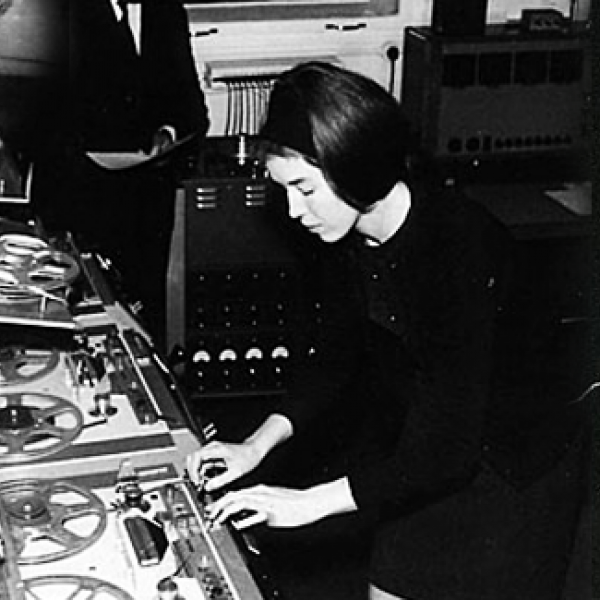
The delightful Delia at work in the studio:
Wow, you really know your stuff. I play a bit and I can appreciate that there is structure in there.
I can see where Kraftwerk got a bunch of their influences. Check this video out: https://www.youtube.com/watch?v=hWUiLJnEYJI
What I don't get is the video in the background being projected onto a screen from the camera to the left. I had NO IDEA they had live feed projectors in 1970.
Sorry for all the verbiage but it's quite rare I run into anyone who has ever heard of them or her. Not many of my friends were into music like this back then, we were all Rockin' to Zep and the Stones, et al. As you said, I could sense the structure behind it and knew it was more of a novelty. Still, I never was a huge fan of electronica but kept up with a few, like Kraftwerk. Of course the VCS3 went on to be used by so many more contemporary bands as time went on, mainly due to pioneers like these.
You said you play some. What instrument(s)? You might want to stop by one of our Friday Night Guitar Threads and let us hear what you do. Despite the name we welcome any instrument, any skill level.
Dude, you are talking to someone that takes 6 paragraphs to write out what most normal people can just say with a sentence or two. I'm stuck always being able to see the contexts that my stuff can be viewed from so I have to engineer a context to funnel readers to the point I need to make.
I am a SERIOUSLY boring person!
:)
The older I get the further back in time each decade / generation feels like the present. It is so bloody interesting seeing all the innovation happening at that time in music and art. If you have a background in IT, you will probably also know that basically everything except wireless and mobile phones were either invented or experimented with back then. The most advanced programming language on the planet is still Lisp, which was invented in the 50s, even further back.
I kind of wonder what motivated these groups to experiment and do all that electronic stuff. I suppose it was inevitable. I think I am understimating the level of sophistication of people and technology back then.
I play guitar, not very well but I can hit a chord or two. This will sound stupid, of course, but I recently watched a bunch of stuff and a documentary on Carol Kaye (oh! another idea for a post!) from the wrecking crew and was blown away by her saying things like "why don't just learn some chords instead of all that fiddly stuff". And then I found bout the circle of fifths and saw a video of a music teacher teaching seniors how to use the circle of fifths to come up with melodies.
All of a sudden a whole bunch of music makes sense. You can always hear there was a pattern behind it ... heh ... but now I can just refer to a chart.
I'll keep an eye on the Friday thing, I have to get a bunch of code out of the door.
What do you play?
(post is archived)