
It might sound a bit chaotic and nonsensical, but what can't be ignored is its intelligence. Created by three people with a deep understanding of music: David Vorhaus, a classical bass player whose background lies in physics and electro engineering, Delia Derbyshire, who had (under)famously electrified the Doctor Who theme tune some 5 years earlier (1963), and Brian Hodgson, a composer and sound technician who, alongside Derbyshire, co-founded Unit Delta Plus (created in order to make and promote electronic music).
David Vorhaus – a classical bass player with a background in physics and electronic engineering.
Delia Derbyshire - a sound scientist at the BBC Radiophonic Workshop.
Brian Hodgson – former member of electronic music project Unit Delta Plus.
Paul Lytton – percussion
John Whitman, Annie Bird, Val Shaw – vocals
Formed by members of the BBC Radiophonic Workshop (the sound effects department), the idea behind White Noise (1968) is immediately clear — electronic effects and samples used to melodic, dramatic and occasionally uncomfortable ends. Initially intended to be a two song single release, record label Island urged White Noise to create a full album. One year later, created in the Kaleidophon Studio—essentially a flat in Camden Town—White Noise released An Electric Storm, which went on to influence generations of electronic musicians.
In June 1969 White Noise released the groundbreaking album An Electric Storm on Island Records. The album was created using a variety of tape manipulation techniques, and used the first British synthesizer, the EMS Synthi VCS3. Amongst many oddities, the first track on the album, Love Without Sound, employed sped-up tape edits of Vorhaus playing the double bass to create violin and cello sounds. Although not initially commercially successful for Island, the album is now considered an important and influential album in the development of electronic music.
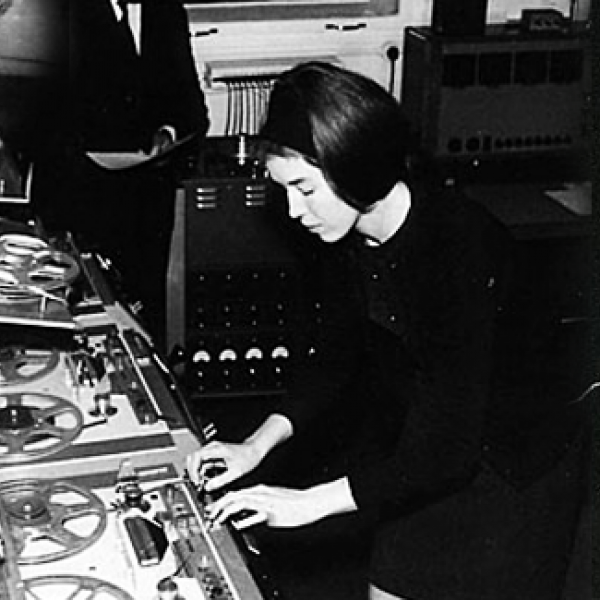
The delightful Delia at work in the studio:
(post is archived)