WelcomeUser Guide
ToSPrivacyCanary
DonateBugsLicense

©2026 Poal.co

592

Https://files.catbox.moe/wo1tkf.png

bigio: proud jew madsen: apparently 'danish' yet has typical jew brow braun: jew acra: obvious jew brandt: tries to hide what he is, but a look in his genealogy reveals a levy and an esther: https://www.geni.com/people/oswald-brandt/6000000175331281889 haven't looked into the other two yet but they have that obvious levantine look

mevs– youri mevs, gregory mevs, fritz mevs sr, fritz mevs jr – cooking oils, industrial parks, baseball manufacturing under the win group. in the mid 90s they led a group to develop a $10 million cement plant in haiti. about win groupthe haiti-based, mevs family-held win group is one of the caribbean's largest conglomerates with stakes in diverse industries such as warehousing and storage, port operations and ethanol processing.

http://faculty.webster.edu/corbetre/haiti/misctopic/ethnic/jewshistory2.htm

"like most of the other jews who remain in haiti, bigio is considered extremely wealthy in a country where 50 percent of the population is illiterate and 76 percent of children under 5 are underweight or suffer from stunted growth.

"i don't think there's resentment against people who are rich here," says the retired businessman, who speaks english, french and haitian creole. "if you know how to manage success, people admire you instead of hate you."

"most of the jewish families in haiti were in the textile and retail businesses," he said. "we're also in industry and trading. we have a small steel mill, we distribute edible oils, and we work a little in banking."

bigio is also the honorary consul of israel in haiti, which explains the enormous israeli flag flying in front of his house -- as well as his bulletproof mercedes suv.

asked if he's ever experienced anti-semitism in haiti, bigio laughed.

"on the contr ary, the haitians have a lot of respect for the jews, and a lot of admiration for israel," he said, pointing out that haiti voted for the united nations partition of palestine in 1947, which created israel.

https://www.multinationalmonitor.org/hyper/issues/1995/01/mm0195_10.html

"the interconnectedness of the haitian business community is amazing. i worked for a company and the guy right across the hallway from me, one of the partners, was general cedras’s brother; the other was a european businessman. my company had one partner whose sister is married to the european businessman, who’s in business with cedras’s brother. the elite are somehow interconnected or related. basically they have to work together in order to keep their power intact.

you can imagine what kind of pressure that must be when you know that there are six million peasants that basically could rise up and tear your house down some night, which, also, i experienced. i’ve witnessed what they call dechoukage where they just basically firebomb, loot and gut a house. its a terrifying thing.

this is always in the mind of the elite haitians. they ride around in their armored vehicles, they have their uzis in their house. it’s not uncommon to hear machine gun fire when you’re in port-au-prince just because there’s a thief trying to break in somewhere. and you’d better believe these rich people have got machine guns. the poorest haitians cannot rise up. i mean there will not be a revolution in haiti because you cannot fight these machine guns with sticks and rocks and machetes. there’s only so far you can fight.

mm: where do the u.s. businesses fit into that whole picture economically and politically? are they part of that elite?

james: the rich haitian families basically run their own empires. you have partnerships with american businessmen, european businessmen that are very lucrative because you have a monopoly situation in haiti. there are only a certain amount of players, and if you can provide something that no one else can provide, you’re in. if you have a sister-in-law that’s, say, from vietnam or thailand who has connections who can get you all the rice you want to import, then you’re the guy that owns the rice market in haiti.

mm: what are the leading empires?

james: there are probably a group of about 30 families, big families. then, after that, maybe another hundred or two hundred at the next level. there aren’t many people, relative to the entire population, running the show. and, let me tell you, the wealth is unbelievable. i know some of these people that send their kids to private schools in florida and switzerland, grammar schools where they’re paying $18,000 a year for one child’s tuition. they are multi-, multi-millionaires. they have a monopoly on the situation. they’re maybe importing rice, then they may export coffee or oranges or whatever. and of course they are making their money from the sweat and blood of the poor haitian, who’s making maybe $20 a month, if he’s lucky.

mm: have the labor costs been that low for a long time?

james: always, and the rich plan to keep it that way, that’s how they make their money. slavery is alive and well in haiti. that’s what it is, slavery. it’s even worse than slavery, really, because at least with slavery you were offered some fringe benefits, as far as housing. in this situation, you’re offered hard labor and that’s it. if you get enough money to buy a machete so you can chop down a few trees to weave together a hut and pack mud on the side of it, good for you. if not, tough luck. they don’t provide housing, they don’t provide food for these people, they just use them for labor.

the first day i was at my office, one of the haitian businessmen came in and i said, “i can’t believe how poor these people are.” this guy was one of the elite, light skin, blue eyes, and he said to me: “oh yeah, we have to keep these people tired and hungry, otherwise they’ll rise up against us.”"

mm: do you think the u.s. government fears a possible uprising?

james: an uprising of the peasant majority? there’s no way that the haitian peasants can rise up. you have one section of the black population which is now aligned with and making money with the rich. not much, but more than they could make as a farmer cutting mangoes. so now they have a gun and are in control. they’re making a few bucks. the rich tell them to go out and take down some village, shoot up a couple of people, chop their face off, leave them in the street, and they’ll do it.

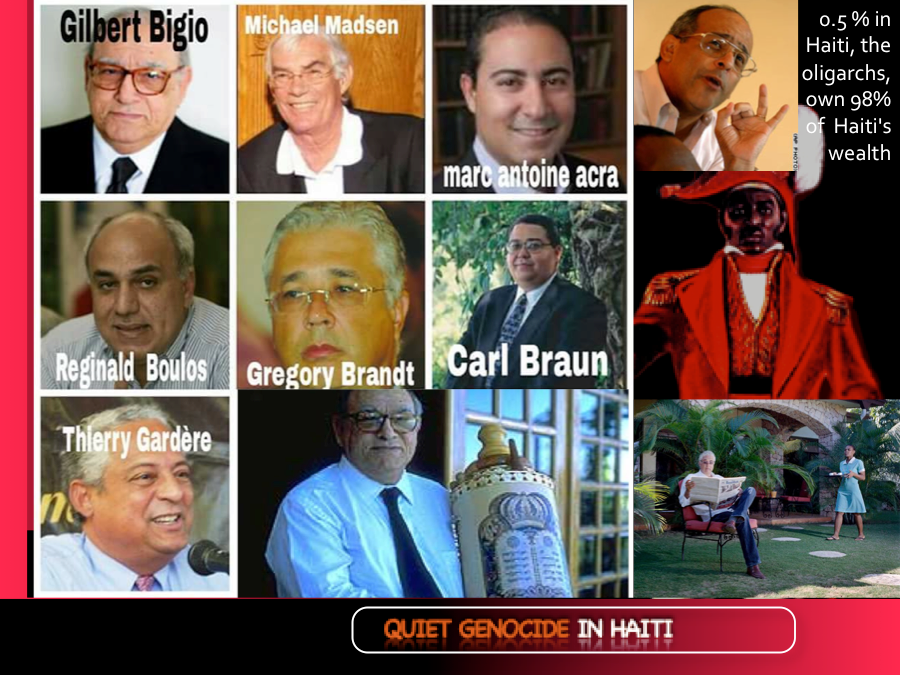
Https://files.catbox.moe/wo1tkf.png bigio: proud jew madsen: apparently 'danish' yet has typical jew brow braun: jew acra: obvious jew brandt: tries to hide what he is, but a look in his genealogy reveals a levy and an esther: https://www.geni.com/people/oswald-brandt/6000000175331281889 haven't looked into the other two yet but they have that obvious levantine look mevs– youri mevs, gregory mevs, fritz mevs sr, fritz mevs jr – cooking oils, industrial parks, baseball manufacturing under the win group. in the mid 90s they led a group to develop a $10 million cement plant in haiti. about win groupthe haiti-based, mevs family-held win group is one of the caribbean's largest conglomerates with stakes in diverse industries such as warehousing and storage, port operations and ethanol processing. http://faculty.webster.edu/corbetre/haiti/misctopic/ethnic/jewshistory2.htm "like most of the other jews who remain in haiti, bigio is considered extremely wealthy in a country where 50 percent of the population is illiterate and 76 percent of children under 5 are underweight or suffer from stunted growth. "i don't think there's resentment against people who are rich here," says the retired businessman, who speaks english, french and haitian creole. "if you know how to manage success, people admire you instead of hate you." "most of the jewish families in haiti were in the textile and retail businesses," he said. "we're also in industry and trading. we have a small steel mill, we distribute edible oils, and we work a little in banking." bigio is also the honorary consul of israel in haiti, which explains the enormous israeli flag flying in front of his house -- as well as his bulletproof mercedes suv. asked if he's ever experienced anti-semitism in haiti, bigio laughed. "on the contr ary, the haitians have a lot of respect for the jews, and a lot of admiration for israel," he said, pointing out that haiti voted for the united nations partition of palestine in 1947, which created israel. https://www.multinationalmonitor.org/hyper/issues/1995/01/mm0195_10.html "the interconnectedness of the haitian business community is amazing. i worked for a company and the guy right across the hallway from me, one of the partners, was general cedras’s brother; the other was a european businessman. my company had one partner whose sister is married to the european businessman, who’s in business with cedras’s brother. the elite are somehow interconnected or related. basically they have to work together in order to keep their power intact. you can imagine what kind of pressure that must be when you know that there are six million peasants that basically could rise up and tear your house down some night, which, also, i experienced. i’ve witnessed what they call dechoukage where they just basically firebomb, loot and gut a house. its a terrifying thing. this is always in the mind of the elite haitians. they ride around in their armored vehicles, they have their uzis in their house. it’s not uncommon to hear machine gun fire when you’re in port-au-prince just because there’s a thief trying to break in somewhere. and you’d better believe these rich people have got machine guns. the poorest haitians cannot rise up. i mean there will not be a revolution in haiti because you cannot fight these machine guns with sticks and rocks and machetes. there’s only so far you can fight. mm: where do the u.s. businesses fit into that whole picture economically and politically? are they part of that elite? james: the rich haitian families basically run their own empires. you have partnerships with american businessmen, european businessmen that are very lucrative because you have a monopoly situation in haiti. there are only a certain amount of players, and if you can provide something that no one else can provide, you’re in. if you have a sister-in-law that’s, say, from vietnam or thailand who has connections who can get you all the rice you want to import, then you’re the guy that owns the rice market in haiti. mm: what are the leading empires? james: there are probably a group of about 30 families, big families. then, after that, maybe another hundred or two hundred at the next level. there aren’t many people, relative to the entire population, running the show. and, let me tell you, the wealth is unbelievable. i know some of these people that send their kids to private schools in florida and switzerland, grammar schools where they’re paying $18,000 a year for one child’s tuition. they are multi-, multi-millionaires. they have a monopoly on the situation. they’re maybe importing rice, then they may export coffee or oranges or whatever. and of course they are making their money from the sweat and blood of the poor haitian, who’s making maybe $20 a month, if he’s lucky. mm: have the labor costs been that low for a long time? james: always, and the rich plan to keep it that way, that’s how they make their money. slavery is alive and well in haiti. that’s what it is, slavery. it’s even worse than slavery, really, because at least with slavery you were offered some fringe benefits, as far as housing. in this situation, you’re offered hard labor and that’s it. if you get enough money to buy a machete so you can chop down a few trees to weave together a hut and pack mud on the side of it, good for you. if not, tough luck. they don’t provide housing, they don’t provide food for these people, they just use them for labor. the first day i was at my office, one of the haitian businessmen came in and i said, “i can’t believe how poor these people are.” this guy was one of the elite, light skin, blue eyes, and he said to me: “oh yeah, we have to keep these people tired and hungry, otherwise they’ll rise up against us.”" mm: do you think the u.s. government fears a possible uprising? james: an uprising of the peasant majority? there’s no way that the haitian peasants can rise up. you have one section of the black population which is now aligned with and making money with the rich. not much, but more than they could make as a farmer cutting mangoes. so now they have a gun and are in control. they’re making a few bucks. the rich tell them to go out and take down some village, shoot up a couple of people, chop their face off, leave them in the street, and they’ll do it.

(post is archived)

[–] 0 pt

Makes sense.

They're so focused with the tip of their nose, they forget that their schemes are 100% unsustainable and if all was allowed, they would also perish.