

A rectangle
Imaginations are formated, "reality" itself is perceived, through a particular rectangle
https://en.wikipedia.org/wiki/16:10_aspect_ratio
>16:10 (8:5) is an aspect ratio mostly used for computer displays and tablet computers. The width of the display is 1.6 times its height. This ratio is close to the golden ratio "{\displaystyle \varphi }\varphi " which is approximately 1.618.
>In 1876, the German scientist Gustav Theodor Fechner studied human responses to rectangular shapes, concluding that rectangles with an aspect ratio equal to the golden ratio are most pleasing to the human eye. To validate his experimental observations, Fechner also analyzed the aspect ratios of more than ten thousand paintings.
https://www.omnicalculator.com/math/golden-ratio
>The golden ratio, also known as the golden section or golden proportion, is obtained when two segment lengths have the same proportion as the proportion of their sum to the larger of the two lengths. The value of the golden ratio, which is the limit of the ratio of consecutive Fibonacci numbers, has a value of approximately 1.618
https://upload.wikimedia.org/wikipedia/commons/4/44/Golden_ratio_line.svg
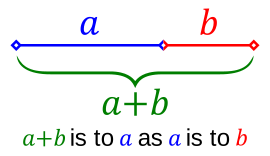
...
Also https://globalnews.ca/news/4194106/440-hz-conspiracy-music/
>If musical performances were to sound the same the world over, some standardization was required. As early as 1885, the Music Commission of the Italian Government declared that all instruments and orchestras should use a tuning fork that vibrated at 440 Hz, which was different from the original standard of 435 Hz and the competing 432 Hz used in France. In 1917, the American Federation of Musicians endorsed the Italians, followed by a further push for 440 Hz in the 1940s. In 1953, a worldwide agreement was signed. Signatories declared that middle “A” on the piano be forevermore tuned to exactly 440 Hz. This frequency became the standard ISO-16 reference for tuning all musical instruments based on the chromatic scale, the one most often used for music in the West. All the other notes are tuned in standard mathematical ratios leading to and from 440 Hz. This tone standard is now universally accepted, which is why a piano in Toronto sounds exactly the same as a piano in China. Weirdly, no one can say for sure why this frequency was chosen in the first place. In fact, there those among us who vehemently disagree with this standard. In fact, they consider the 440 Hz middle “A” to be an abomination against nature. Adherents to this theory claim that a more “natural” frequency for middle “A” is 438 Hz. Others believe that the correct middle “A” is 432 Hz (also known as Verdi’s A) because it has “a pure tone of math fundamental to nature” and is “mathematically consistent with the patterns of the universe, vibrating with Phi, the Golden Ratio.
(post is archived)